Wednesday, December 3, 2008

The Challenge


The challenge I have set for this final research paper is to' follow my further interest' by reflecting on my learning process and the content in COMIC BOOKS AND GRAPHIC NOVELS IN SCHOOL AND PUBLIC LIBRARIES (University of Alberta LIS 518 ). I am looking specifically for those areas that challenged me, ergo my title--The Challenge.


My real challenge is to think about all I've learned and figure out how to share this with other teachers specifically, and other readers in general. I feel like I am in a position to advocate for graphic novels and comics, most especially their use in schools. But I will need ammunition!


Reflection

Why was my previous response to the idea of Graphic Novels and comics so negative?

Ignorance

My age and background


What have I learned?

Lots! And there is a lot more to learn. Graphic novels and comics are becoming more available all the time as interest from readers grows.Graphics are part of everyday life and educators want to help students develop and refine their visual literacy skills. Research shows that using graphic images is a powerful aid to learning.


What key things changed my understanding and inclination to read and buy comics and graphic novels for the school library?

Exposure to course resources, reviews, scholarly writings, and educated opinions all had a profound impact, but actually reading comics and graphic novels for myself clinched it.


Why the blog?

Writing about my new ideas and impressions will cement my learning and change my personal reading behaviour. I want to use this blog as a storehouse of resources so that I can convince other Teacher Librarians, students, and friends to buy, read and share comics and graphic novels.


What is the big picture piece I want to know more about and take with me into the future?

I want to understand how comics and graphic novels illuminate aspects of our current culture, in particular, the world of young people.

I want to know more about using Comics and Graphic Novels in educational settings


Where I started

I don't think anyone can grow unless he's loved exactly as he is now, appreciated for what he is rather than what he will be.
Fred Rogers
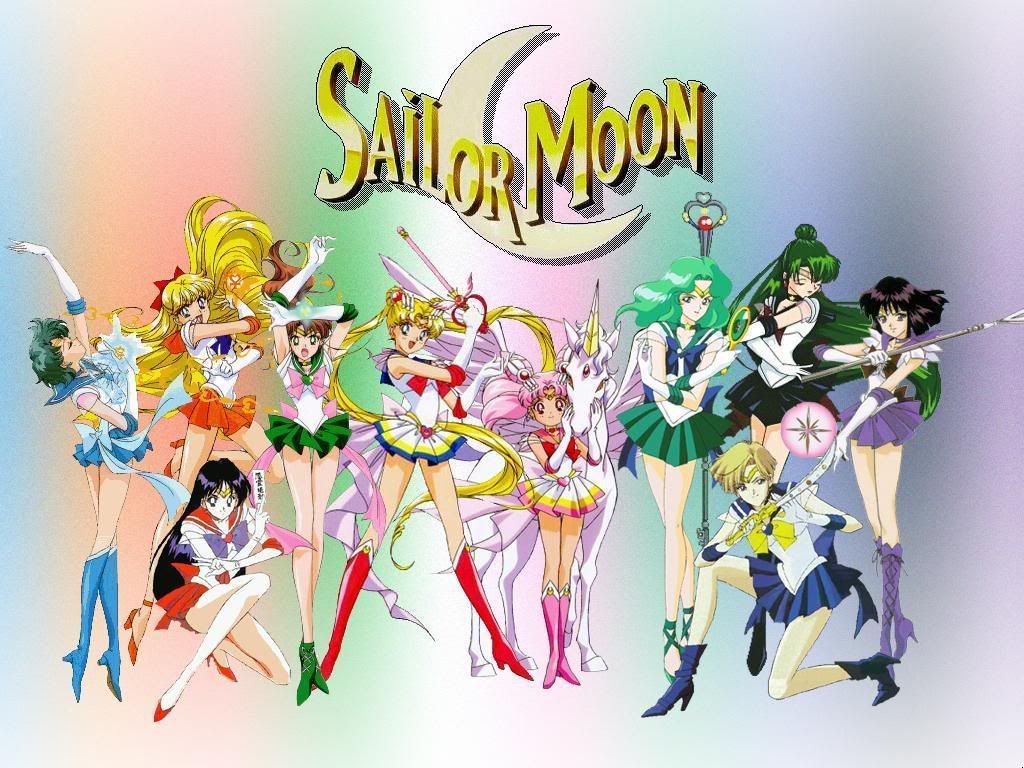
I realize now, that I started this course with a very cursory understanding of the worlds of comics and graphic novels. I knew a little bit about the popularity of Manga with high school/middle school girls—(but I was turned off by the images myself). I also knew a little about comic books---but again, I was not drawn to them because my perception was based mostly on images I found sexist and shallow.

I had never taken the time, as an adult, to read a comic book or a manga title. So, a willingness to overcome complete ignorance was the first step of the journey.

Trying to borrow or buy all the titles on the reading list took me further down the road. As I gathered the books, just looking at the covers I could see that there was huge variety here that I hadn’t known about. The only title I had read before was Persepolis. Obviously, there was much that I was unfamiliar with.

My classmates, however, didn’t all start with such limited experience. As I read through the discussions, seminars and other projects I realized comics and graphic novels had some well-versed and knowledgeable devotees. Reading their thoughts, opinions and comics-related experiences was another valuable aspect of my learning. I know that sharing my thoughts and impressions enhanced my learning, too. Manipulating and engaging with the material made me delve much deeper.

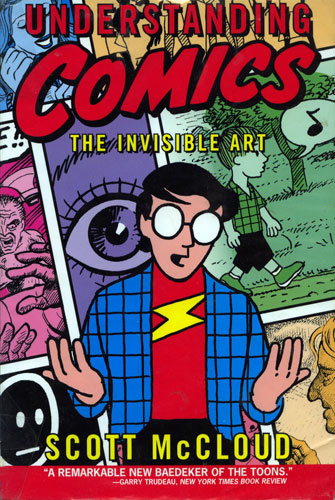
To be able to participate fully I needed to expand my vocabulary. To rectify this I have poured over Scott McCloud’s book Understanding Comics repeatedly. Reading a philosophic treatise in graphic novel format was a completely new experience. I found it hard to comment on the different chapters because I was highlighting every word! Understanding Comics was so full of new terms and concepts it was mind-boggling.In the Introduction, McCloud describes his intentions for the book in this way:

Although there is some history in it…it’s more of an examination of the ART- FORM of comics, what it’s capable of, how it workshow do we define comics, what are the basic elements of comics, how does the mind process the language of comics…I have a chapter on closure---all about what happens between the panels….there’s one on how time flows through comics, another on the interaction of words and pictures and storytelling. I even put together a new comprehensive theory of the creative process and its implications for art in general!!”.

Learning to think about comics as a unique and worthy art form has led me into new territory, and the teacher in me is eager to share my new knowledge.


Universes beyond my knowing

I have wondered a lot about the appeal of superheroes. At the risk of sounding wildly repetitive, as a middle-age woman of a literary bent, I'm not drawn to the images---- so I haven't read much of the genre. Too bad for me! There is a lot in the superhero world that I would like if I'd given it half a chance.


Every adolescent male and quite a few females, seem to enjoy the time they spend in this alternate world. So do millions of others, evidently. Superheroes are big business. Superman, Spiderman, Batman and more are all guaranteed winners at the box-office. Superheroes seem to have become part of mainstream culture.

In this age, when image is all, it might even be suggested that performing artists, professional wrestlers and athletes are the superheroes of our day reflecting our martial culture and obsession with the body. Movies like Ironman muse on the true costs of the US military machine, while Frank Miller and Lynn Varley's 300 draws parallels between the Spartans and the US mission in Iraq---both saving democracy, evidently. But financial success is not the only measurement of the genre.


I am newly interested in the world of the superheroes because of the personal relevancy young people seem to find in the personalities and exploits of the superhero characters. Gene Kannenberg Jr. writes, in 5oo Essential Graphic Novels :
It was Stan Lee's revolutionary approach of imagining the superheroes as real people with down-to-earth problems that really fired the public's imagination. These were heroes as ordinary human beings that teenagers could identify with.
This is a genre that keeps evolving, keeps re-inventing itself. Contemporary issues are explored but escapism is still available. The young people I know that read these, enjoy the humour, the adventure and the ideas. They are quite passionate about the details of the different universes. There is a lot of self-referential hijinks, which everyone seems to enjoy. 'Knowing the inside jokes' adds to the fun. These days it seems to be kind of cool to be a comic/superhero geek. (Even I remember the multiple Seinfeld references to Superman).


According to my classmate, Adam, there are superhero titles for all tastes. He described one comic, that focuses on the characters (city workers) who clean up the mess left from superhero battles.Now that sounds like a comic a mom could like!

Tuesday, December 2, 2008

The Power of the Image


What is it about drawn images, as opposed to real people, that resonate with youth and their culture?


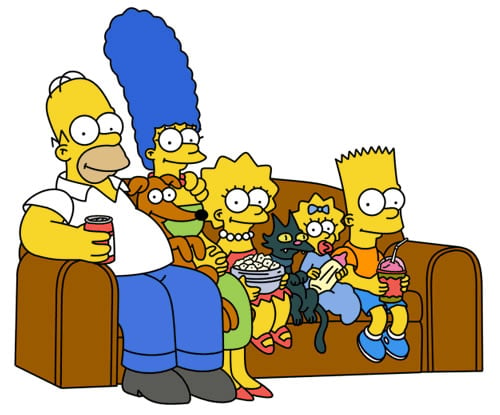
I would include here the plethora of cartoon characters that dominate our daily cultural lives—the Simpsons, Futurama, Family Guy, South Park, King of the Hill -- all animated images on mainstream, primetime, network TV. Do our youth look to these characters to explain our culture?


I frequently have a negative reaction to characters on the Simpsons, and I can barely (and rarely) bring myself to watch South Park—even though I know it represents a significant voice of culture for my kids and my high school students. If I want to know what's influencing them I need to be aware of what they watch on TV and what they talk about.


What I don't like about these characters is I frequently find them to be rude, gross and stereotypical. Evidently, that's what makes them so funny.


Both animated and graphic comics seem focus on many things I don’t like about our culture. That's nothing new.The purpose of comics has always been to rattle the cage of cultural complacency. Most of the time I can see past what disturbs or offends me to see that comics today hold up for ridicule our cultural idiosyncrasies and mis-steps (e.g. rampant consumerism and political hypocrisy), and suggest,through humour, that our children become something different---become a new kind of thinker and doer.


In this context I think the writers of graphic novels and comics are ahead of the crowd. Their chosen visual format appeals strongly to the young. It behooves educators to help students decode the images that come at them from every direction.


Visual literacy (or, as it is colloquially known, visuacy[1]) is the ability to interpret, negotiate, and make meaning from information presented in the form of an image. Visual literacy is based on the idea that pictures can be “read” and that meaning can be communicated through a process of reading
.http://en.wikipedia.org/wiki/Visual_literacy


There were lots of signs. Just none that you could read.---The Horse Whisperer


What's the problem?

I think I shared at the beginning of this course, that even though my husband, sons and to a lesser degree my daughter, love comics and are especially drawn to superheroes and the films that have been created in the last few years I was not interested in them. I knew, that at the library where I was working there was a solid base of kids who are anime/manga devotees, but I didn’t really see why we might need to add to the collection, other than in that specific and limited genre.


Now I do.


I think my initial disinterest in comics and graphic novels really stemmed from an aversion to the sexualized drawings. My inner stereotype of images of " women in comics" made me uncomfortable with the idea of purchasing and shelving these books and disinterested in reading them myself. This raised two issues for me:

One, revolves around censorship and informed selection policies. Who was I buying books for (high school library, personal interest/collection)? Knowing my audience, and forcing myself to learn more about comics by immersion in the genre helped me get past my resistance and able to learn more about the huge variety of genres represented today in comics and graphic novels.


Two, the power of images.I think I am very much a product of my prudish North American culture (born in the late 1950s). I have mentioned this in our discussions---I frequently find the images overwhelming. The blood and gore in the heroic epics like 300, or the depictions of animals dying in Pride of Baghdad are too much for me, too.


I don’t think most younger people react that way, and that has got to be part of the appeal. In a TV/Movie/Computer screen world the ability to read IMAGES is required. The ability to distance oneself from the images is also required.


I think part of what I’m struggling with is the fact that if middle-aged women are in charge of purchasing the graphic novels for their libraries, if they have similar reactions to mine, and are similarly uninformed, they probably aren’t buying too many!


One of the biggest issues when it comes to graphic novels
is that of explicit material. Certain genres such as horror, the
supernatural, crime and punishment, satire and dark humour will
be identified as being more likely to cause upset amongst readers
or their parents/guardians, due to content. (Gorman, 8/1/2002)
At the Emanuel School, the staff were confronted with this problem
after purchasing the first set of graphic novels that included titles
by the author, Clive Barker. The library already had copies of
books by this author – both the “Weaveworld” and the “Books
of Blood” series, which contain explicit language and sexual
references. However, the inclusion of the graphic novels of this
author was deemed inappropriate for our school library because
the sexual content and violence were presented in picture formats,
thus impacting in a different way. It is interesting to note that
other books with similar content such as “Vernon God Little” are
considered acceptable, but graphic novels on similar topics may
not be simply because it is not just text, but images. Censoring
such material depends on many variables including audience,
location, cultural and religious considerations and so on.
With particular reference to Manga titles, again, it is extremely
important to view the collection. Browsing a collection of Manga
will confront you with graphic images of violence and sexuality
and in some cases mild pornographic material. Titles such as
“Fair Skinned Beauty”, “Hot Tales” or “Immoral Angel” all have
warnings indicating that they contain extreme sexual situations.
You will have these same titles in the catalogue or collection, as
you will "Astro Boy" (Lee)


I did some polling of the Teacher-Librarians in my school district---only one is interested in graphic novels.( She lived in Japan for a while and became a fan of manga then). The others have some in their collections, but they depend on reviews and recommendations for their purchases. It is a similar story with other teachers. Most say they don't have time/interest to learn about comics and graphic novels. One of my purposes in writing this assignment is gathering my resources together so I can do a little proselytizing! I am now convinced that I'll read more graphic novels for personal pleasure and I want to use them in my teaching practice.


To address this concern, I returned many times to The ABCs of Graphic Novels (Gail de Vos, 2005). Her recommendation is to recognize that this is a relatively new, non-standardized medium, so it is important to find material that is appropriate for the intended audience. Format information is not enough. Just describing something as a Graphic Novel or Comic book really doesn’t do it.

Graphic Novels and Social Studies possibilities


Since I am a teacher, I find myself especially drawn to books that will support ‘institutional’ learning and reading---anything remotely related to social studies really fills my boots. History books are so often jammed with dense acres of text, they seem to provide challenges for all learners. The additional support that graphic novels and comics can provide is immense.


Most publishers point to the changing face of the modern world as a prime mover behind the trend. Today's children are the first generation to grow up more accustomed to digital screens than the printed page; as wireless devices proliferate, kids increasingly understand and appreciate data that is transmitted to them in visual form." (Bickers)


"We live in a visual society, and providing illustration to support storytelling is extremely appealing to young readers," said Marlaine Maddux, editor-in-chief of Penny-Farthing Press,... "In our attempt to attract new readers, we shouldn't forget that we are competing with the most visual medium of them all--television.”(Bickers)


With the use of graphic novels and comics, students can be supported and engaged in:


Knowing their country’s history

Knowing key figures in the national story

Knowing stories about the ancient worlds and civilizations

Knowing about current events in the larger world


There are limitless possibilities here, depending on the will of the creators and publishers.


One example, of particular interest to me is the series produced by the Lerner Publishing Group--Graphic Universe. These comic-book style educational materials bring a series of myths and legends to life.


Graphic Universe books are intended to bring myths and history to life for young readers aged 9+. ... Titles from Graphic Universe are worked on by experienced comic professionals who have worked with such companies as Marvel and DC Comics.


Graphic Myths and Legends is the first series published by Graphic Universe. There are currently a total of 16 titles in the series. The books are full-color comic retellings of famous myths from around the world, including Hercules and Amaterasu. The series has the trade byline of "Supreme artwork and storytelling." Graphic Myths and Legends is drawn and inked by some of the top artists in the industry.

The following list of titles is irresistible!

The cover of Hercules: The Twelve Labors

* Ali Baba : Fooling the Forty Thieves

* Amaterasu : Return of the Sun

* Arthur & Lancelot : The Fight for Camelot

* Atalanta : The Race against Destiny

* Beowulf : Monster Slayer

* Demeter & Persephone : Spring Held Hostage*

* Guan Yu : Blood Brothers to the End

* Hercules : The Twelve Labors*

* The Hero Twins : Against the Lords of Death

* Isis & Osiris : To the Ends of the Earth

* Jason : Quest for the Golden Fleece*

* King Arthur : Excalibur Unsheathed

* Marwe : Into the Land of the Dead

* Odysseus : Escaping Poseidon's Curse*

* Perseus : The Hunt for Medusa's Head*

* Pigling : A Cinderella Story

* Psyche & Eros : The Lady and the Monster

* Robin Hood : Outlaw of Sherwood Forest

* Sinbad : Sailing into Peril

* The Smoking Mountain : The Story of Popocatépetl and Iztaccíhuatl

* Sunjata : Warrior King of Mali

* Theseus : Battling the Minotaur*

* Thor & Loki : In the Land of Giants

* Tristan & Isolde : The Warrior and the Princess

* The Trojan Horse : The Fall of Troy*

* William Tell : One against an Empire

* Yu the Great : Conquering the Flood

For more details go to Lerner Books


*Pairing these titles with the Age of Bronze series by Eric Shanower would be a stimulating group project.

Why Comics and Graphic Novels work in the classroom

In Gene Yang’s article, “Graphic Novels in the Classroom”, the author of American Born Chinese asks:

And what is a graphic novel anyway? The precise definition of the term “graphic novel” is the subject of deep philosophical debates at comic book conventions everywhere…Me, I define “graphic novel’ as simply “thick comic book.” I call any comic book thick enough to need a spine a graphic novel. “Graphic novel” is really a political term. It’s part of a growing effort to cast the comics medium in a new, more literary light.

By contrast, in Understanding Comics, Scott McCloud defines comics more precisely as:

Juxtaposed pictorial and other images in deliberate sequence intended to convey information and/or produce an aesthetic response from the viewer.

Yang’s further exploration of the effectiveness of using a combination of images and text (“comic lectures”) in education, led to a project for his master’s degree in education.


The exploration of McCloud’s detailed definition consumes another 215 pages of images and text. McCloud’s work is philosophical, educational and fascinatingly detailed. It expands my understanding and appreciation of the world of the comics and all visual and creative art!. Well worth reading for anyone interested in visual literacy and the world of art.


But the purpose of this blog entry is to convince educators to make use of comics and graphic novels in their classrooms. For this reason we'll focus more on Yang's work, (but Understanding Comics is highly recommended).


In "Graphic Novels for the Classroom", Yang describes his occasional practice of preparing comics lectures for his students when he knows that he will be away. The students love the comics and give him feedback that it’s even better than when he’s there in person, leading him to wonder what makes these so effective. He discovers that the visual aspect both appeals to, and helps the students understand the algebra concepts. He connects this success to their love of visual media. He writes:

By combining image and text, graphic novels bridge the gap between media we watch and media we read.

His second point is essential (and explains why I’ve gone back to McCloud’s book so many times):

In comparison to other visual media like film and animation, graphic novels are permanent…graphic novels have a ‘visual permanence’ to them. Time progresses only as quickly as your eyes move across the page…what matters is how fast you choose to read it. The rate of information transfer is firmly in your control…students could rewind and fast-forward the lectures when-ever they wanted.”


In Comics in Education, Yang concludes with a description of the strengths he believes that comics offer to the field of education:

Clearly, the five identified strengths of comics - that comics is motivating, visual, permanent, intermediary, and popular - can be harnessed in practically any subject and at practically any grade level. Many innovative teachers have already done so with much success.


Hot off the press a brand new title:

Teaching Visual Literacy: Using Comic Books, Graphic Novels, Anime, Cartoons, and More to Develop Comprehension and Thinking Skills (Paperback) By Nancey Frey (Editor), Douglas Fisher (Editor)

The articles inside give dramatic support to the idea of using comics and graphic novels in education settings:

  • Visual Literacy: What You Get Is What You See by Lynell Burmark
  • Graphic Novels: The Good, the Bad, and the Ugly by Jacquelyn McTaggart
  • Comics, the Canon, and the Classroom by James Bucky Carter
  • Seeing the World Through a Stranger's Eyes: Exploring the Potential of Anime in Literacy Classrooms by Kelly Chandler-Olcott
  • "Literary Literacy" and the Role of the Comic Book: Or, "You Teach a Class on What?" by Rocco Versaci
  • That's Funny: Political Cartoons in the Classroom by Thomas DeVere Wolsey
  • Learning From Illustrations in Picturebooks by Lawrence R. Sipe
  • An Irrecusable Offer: Film in the K-12 Classroom by Lawrence Baines
  • "It Was Always the Pictures...": Creating Visual Literacy Supports for Students With Disabilities by Paula Kluth


Bibliography

Bickers, James. "The Young and the Graphic Novel." Publishers Weekly. 19 Feb 2007. 62. eLibrary. Proquest CSA. STELLY'S SECONDARY SCHOOL. 03 Dec 2008. .

Crawford, Philip Charles. "AMERICANA POPULAR CULTURE and the COMICS: Studying American Culture through Comics and Graphic Novels." Knowledge Quest. 1 2006. 50. eLibrary. Proquest CSA. STELLY'S SECONDARY SCHOOL. 26 Nov 2008. .


de Vos, Gail. "The ABCs of Graphic Novels"http://www.resourcelinks.ca/features/feb05.htm

Emad, Mitra C. "Reading Wonder Woman's Body: Mythologies of Gender and Nation." Journal of Popular Culture. 6 2006. 954. eLibrary. Proquest CSA. STELLY'S SECONDARY SCHOOL. 27 Nov 2008. .

Frey, Nancy. Teaching Visual Literacy: Using Comic Books, Graphic Novels, Anime, Cartoons, and More to Develop Comprehension and Thinking Skills Ed. Nancy Frey. Corwin Press, 2008.

Kaliakatsou, Ioanna. "A Voice from the Margins: Homeric Myth in Two Contemporary Greek Comics." Bookbird. 3 2007. 22. eLibrary. Proquest CSA. STELLY'S SECONDARY SCHOOL. 27 Nov 2008. .zgreek comics
Kannenberg,Gene Jr. 500 Essential Graphic Novels The Ultimate Guide

Lee, Allison. "Graphic Attraction." This is the html version of the file http://conferences.alia.org.au/alia2004/. 2004. ALIA 2004. 18 OCT 2008 .

Lothrop, Patricia. "TROJANS LOSE, READERS WIN." School Library Journal. 01 Oct 2004. S16. eLibrary. Proquest CSA. STELLY'S SECONDARY SCHOOL. 26 Nov 2008. .

O'Neill,Ted. "Review of Going Graphic: Comics at Work in the Multilingual Classroom, by Stephen Cary" Volume 10, Number 1, June 2006 2 Dec 2008

Schwarz, Gretchen. "Expanding Literacies through Graphic Novels." English Journal. 01 Jul 2006. 58. eLibrary. Proquest CSA. STELLY'S SECONDARY SCHOOL. 27 Nov 2008. .

Tirdad, Derakhshani The Philadelphia Inquirer. "No longer too lowbrow for college classrooms." McClatchy - Tribune Business News. 26 Oct 2008. eLibrary. Proquest CSA. STELLY'S SECONDARY SCHOOL. 27 Nov 2008.

Yang,Gene. "Graphic Novels in the Classroom" Language Arts; Jan 2008; 85, 3; ProQuest Education Journals


Yang, Gene. "Comics in Education"http://www.geneyang.com/comicsedu/print.html. 2003 1 Dec 2008

The Reading List

Graphic novels:

Bechdel, Alison. 2006. Fun Home: A Family Tragicomic. Houghton Mifflin, 0-618-47794-2.

Medley, Linda. 2006. Castle Waiting. Fantagraphics. 1-56097-747-7.

O’Malley, Bryan Lee. 2004. Scott Pilgrim: Vol.1: Scott Pilgrim’s Precious Little Life. Oni. 978-1932664089.

Petersen, David. 2007. Mouse Guard: Fall 1152. Archaia Studios Press. 978-1-932386-57-8

Runton, Andy. 2004. Owly: The Way Home & The Bittersweet Summer. Top Shelf, 1-891830-62-7.

Saki, Stan. Usagi Yojimbo: Book One. Fantagraphics. 978-0930193355.

Satrapi. Marjane. 2003. Persepolis. Pantheon. 0-375-42230-7.

Soo, Kean. 2008. Jellaby. Hyperion Paperbacks for Children. 978-142310303-5.

Tamaki, Mariko and Jillian Tamaki. 2008. Skim. Groundwood. 978-0888997531.

Tan, Shaun. 2006. The Arrival. Arthur A. Levine Books. 978-0-439-89529-3.

Yang, Gene Luen. American Born Chinese. First Second. 1-59643-208-X.


Manga Titles

Arakawa. Hiromu. 2005. Fullmetal Alchemist, Volume 1. VIZ Media LLC. 978-1591169208.

Azuma, Kiyohiko. 2003. Yotsuba&!. ADV Manga. 1-4139-0317-7.

Kishimoto, Masashi. 2003. Naruto: Tests of the Ninja v. 1. Viz Media, Subs. of Shogakukan Inc; Shonen Jump Graphic Novel Ed edition. 978-1569319000.

Kubo, Tite. 2004. Bleach: v. 1 Viz Media, Subs. of Shogakukan Inc. 978-1591164418.

Ohba, Tsugumi. 2005. Death Note volume 1: Boredom. Viz Media, Subs. of Shogakukan Inc; Shonen Jump Advanced Graphic Novel Ed. 978-1421501680.


Takahashi, Rumiko. Ranma ½ Vol. 1. Viz, 1-56931-962-6.

Takaya, Natsuki. 2004. Fruits Basket (Vol . 1) Tokyopop. 1-5918-2603-9.